“One thing is for sure: in between the lighter, human moments, the tension and plot continue to build all the way to the end.”
https://readerviews.com/reviews/the-matriarch-mission-trencavel/
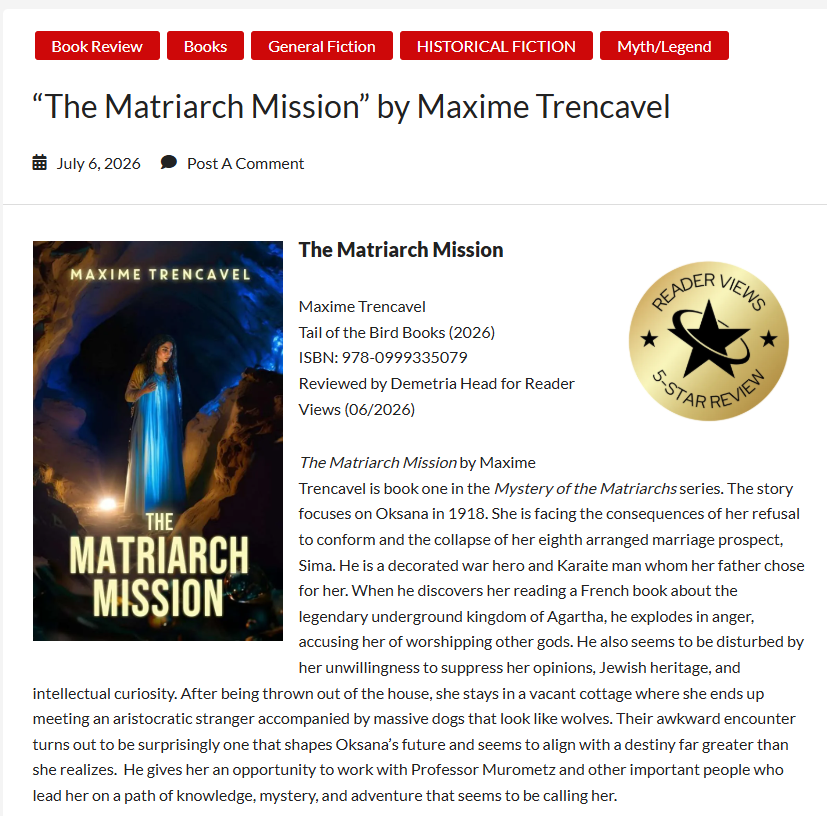
The Matriarch Mission
Maxime Trencavel
Tail of the Bird Books (2026)
ISBN: 978-0999335079
Reviewed by Demetria Head for Reader Views (06/2026)
The Matriarch Mission by Maxime Trencavel is book one in the Mystery of the Matriarchs series. The story focuses on Oksana in 1918. She is facing the consequences of her refusal to conform and the collapse of her eighth arranged marriage prospect, Sima. He is a decorated war hero and Karaite man whom her father chose for her. When he discovers her reading a French book about the legendary underground kingdom of Agartha, he explodes in anger, accusing her of worshipping other gods. He also seems to be disturbed by her unwillingness to suppress her opinions, Jewish heritage, and intellectual curiosity. After being thrown out of the house, she stays in a vacant cottage where she ends up meeting an aristocratic stranger accompanied by massive dogs that look like wolves. Their awkward encounter turns out to be surprisingly one that shapes Oksana’s future and seems to align with a destiny far greater than she realizes. He gives her an opportunity to work with Professor Murometz and other important people who lead her on a path of knowledge, mystery, and adventure that seems to be calling her.
Trencavel writes in such a way that sounds poetic. It brought me into the story, and I did not care how slow the pacing was. I hung onto every word because the author grabbed me by leading with this young girl, who is not afraid to be opinionated or speak her mind. She is not afraid to truly be herself, and that seems to cut against her father’s grain. It was also interesting to follow her life growing up in an era and cultural-religious society that forbade women from speaking and thinking for themselves. So, who would have thought that Oksana would have a chance encounter with the aristocratic stranger, none other than the tsar’s cousin, Grand Duke Nikolai of the Romanovs? The very idea that Jews like her were never allowed inside the palace, and now the Grand Duke is inviting her inside as his guest, is fascinating. It challenges the status quo.
I also found the conversation Oksana had with his wife, Grand Duchess Anastasia, very interesting. She further encouraged Oksana to speak honestly and challenged her worldview. By doing this, the Grand Duchess actually provokes readers like me to think about Rumi, the author of the book of poetry she let Oksana read, who suggests that Jews, Muslims, and Christians all worship the same God. I also loved how she overturned Oksana’s assumptions about power when she states, “The men rule what the world hears and sees, but the strength of our beliefs, our faiths, of our feminine minds has kept the dynasty strong for three centuries.” This statement is powerful, and she is essentially saying women may not always have the visible power, but they shape the decisions behind the scenes.
The story may move along slowly, but it is worth it because there is so much packed in each chapter. The reason Oksana was summoned and why it is so important to the Romanovs is made clear early on. It was presented at the right time to keep readers invested. All of these powerful people are interested in Oksana, and they believe the key to the mystery can only be accessed by her and done safely. Like me, readers will find the conversation among the Romanovs, Murometz, Major General Svechin, Father Georgii, and the high priestess, Mother Evgeniia, at the luncheon, to be compelling. It sets the stage for what is to come later as the story continues to build beautifully.
There was so much about this story that left me intrigued and wanting more. There was nothing I didn’t like about it, from the interesting cast of characters to the different elements added into the storyline: mysticism, occult studies, foreign literature, ancient histories, Oksana’s features resembling one of the tribes of Israel, books about Agartha, and the legend of this mysterious black object that is of everyone’s interest. We get to see two radical personalities, Grand Duchess Anastasia “Stana,” who mentors Oksana, and she’s affectionate. Then there is Professor Murometz, who gives Oksana a very different and much darker version of the same mystery. As the story moves along, I found myself questioning exactly which one is telling the truth. But what I find even more intriguing is this cranial bump that surfaces as being of some genetic importance. The way Trencavel connects it to the mystery is smart. It does a great job piquing the curiosity of its readers. I also found myself appreciating that the author never lost sight of Oksana and her experiences, while the larger mysteries surrounding her destiny, Agartha, and the black object, continued in the background.
There were so many moments throughout the narrative that stood out for me. One of the earlier standout moments was when the Grand Duchess gave her a piece of English literature, Pride and Prejudice by Jane Austen. It is accompanied by a note that says, “Ask yourself if you are an Elizabeth. Read and reflect. Your choices govern your future.” Anyone familiar with this piece of literature will get the implications. She is giving Oksana a lesson, not just a novel. Also, the backstory that Murometz gives regarding the ancestral gene complex that is believed to be from exposure to the mysterious black object, and the hereditary dreams that are believed to be encoded by ancient ancestors, is fascinating. Another moment that made my jaw drop was after Oksana managed to connect with a man who doesn’t challenge her choice of reading, Mirko. She finds out a couple of things. One is good news that would make any woman feel overjoyed, then there is shocking and confusing news that just turns your whole world upside down.
The other moment I felt was major was when Oksana was inside the cavern with Thula, and she finally heard something well-needed after having her entire life and self-image shaped by family, Murometz’s criticism, Yuri’s abandonment, Kamila’s death, and failed engagements. Then we get a detailed back story of the black object and something even more incredible: the land of the giants and how this civilization of monsters was created. This story just continues to impress me from chapter to chapter. I feel like I’ve been given an interesting history lesson about Sami traditions, Hyperborean legends, and mysterious beings, especially in chapters thirteen through fifteen.
I enjoyed how the plot just continued to thicken, especially as we learn more about Oksana’s calling after meeting Thula. Then, part two of the narrative goes out with a shocking bang for Oksana as she learns of someone very close to her deceiving her. By part three, there are key people missing, and power plays by the Cheka are at work. The way the author sets up this story is not through a lot of worldbuilding, although it is present. But the characters are allowed to share the historical lessons, and it works so well for this narrative. It blends naturally through conversations. For example, I was glued to the pages when Ekaterina, Murometz’s wife, shared more about the black object, the blue light, the bump, and the importance of procreating with someone who shares the same bump. But this part of the story also brings more things to light and brings it back full circle. After traversing different parts of Russia, making sacrifices, enduring losses, and regaining those who have been declared dead on paper, Oksana is back in her village, and it is the year 1926. But she is still carrying the weight of missing Ariella. One thing is for sure: in between the lighter, human moments, the tension and plot continue to build all the way to the end. More revelations surface about Mirko and Evgeniia, the high priestess. Readers will definitely stay immersed in this story.
Overall, The Matriarch Mission uncovers an ancient mystery, but it is also about womanhood, motherhood, sacrifice, and love disguised as a mystical adventure. While the mysteries drive the plot, Oksana’s emotional journey is the true heart of the story. She discovers so much about herself that goes beyond her intelligence, telepathy, lineage, and connection to prophecy. She realizes what love truly is, and it is not romance alone. Trencavel has taken extra care with this story and has brought us a story with a rich historical backdrop and intriguing mysteries. Readers who enjoyed similar works like Katherine Neville’s The Eight would most appreciate The Matriarch Mission.
At a Glance: A historical mystery with mystical and esoteric elements set in post-imperial Russia. A fiercely independent young Jewish woman is drawn into a secret mission involving ancient legends, hidden bloodlines, and prophetic destiny. Explores womanhood, faith, history, and occult themes.
Best for Readers Who Enjoy: historical mystery, esoteric fiction, mystical adventures, Romanov history, ancient civilizations, secret societies, strong female protagonists, Jewish heritage, myth and folklore, slow-burn historical fiction