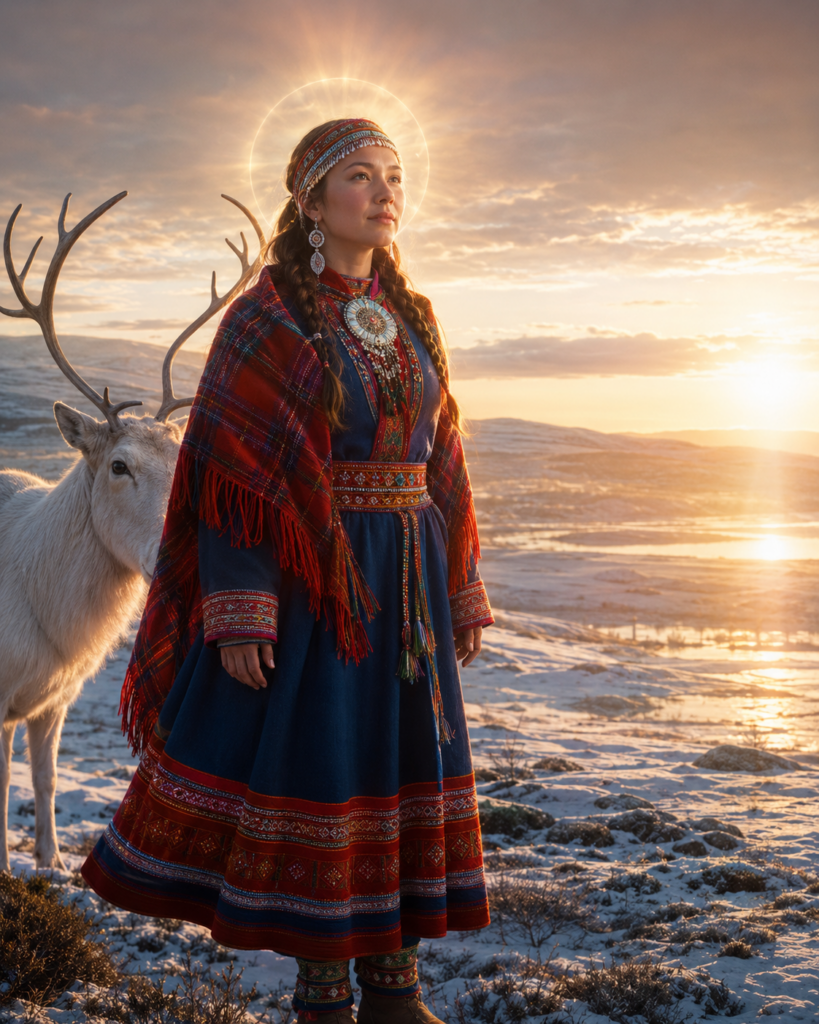
At the extreme northwestern edge of Russia, between the White and Barents seas, the Kola Peninsula appears to be a place made for mythology. For weeks in winter, the sun disappears. In summer, it refuses to set. Mountains rise abruptly from forests and tundra. Lakes occupy the eroded centers of ancient igneous formations. Dark figures appear on cliffs, while isolated stones seem deliberately positioned in the landscape.
Here, three very different bodies of tradition have become entangled: the living sacred geography and stories of the Sámi; the Greek legend of Hyperborea, the paradise beyond the North Wind; and a modern mythology of pyramids, subterranean chambers and vanished Arctic civilizations.
They should not be treated as interchangeable. Yet their meeting on the Kola Peninsula tells a remarkable story about the human desire to find meaning—and perhaps memory—at the edge of the known world.
An Ancient Land, but Not in the Way the Legends Claim
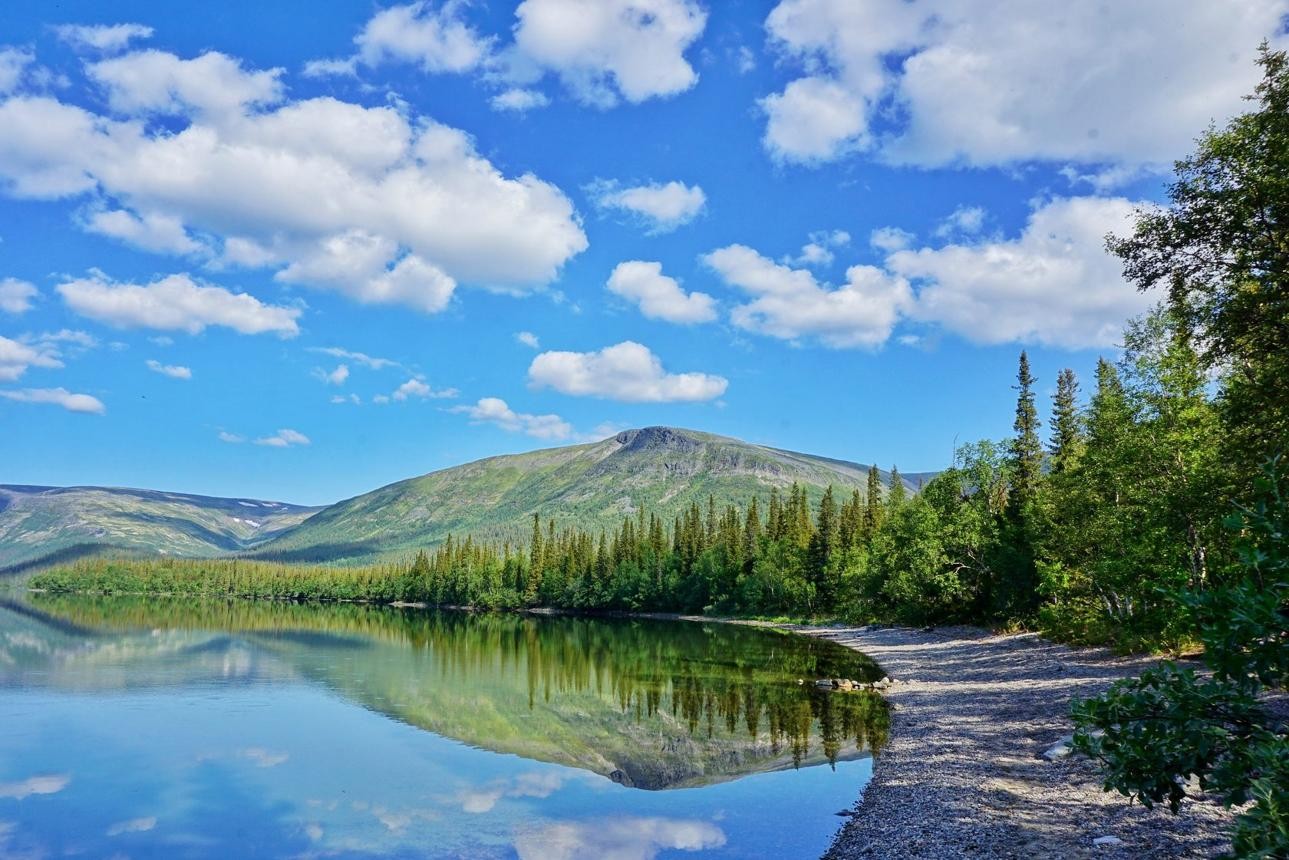 The Kola Peninsula really is unimaginably old. It occupies part of the Fennoscandian Shield and contains some of the planet’s most unusual mineral formations. The Lovozero and Khibiny massifs are enormous alkaline igneous complexes, while the Kontozero formation is the remnant of an ancient volcanic system. Geological studies place the main period of Kola’s alkaline intrusions roughly 380–360 million years ago, with some volcanic activity beginning tens of millions of years earlier.
That geological history matters because it created a terrain that can resemble architecture. Layered mountains appear terraced. Erosion exposes rectangular fractures and enormous slabs. Calderas and intrusions produce circular or horseshoe-shaped formations. Cavities, fissures and buried structures can exist without having been excavated by human hands.
The Kola Peninsula is therefore ancient in the deepest possible sense—but geologically ancient, rather than demonstrated evidence of a forgotten human civilization. Its natural history is already extraordinary enough to explain why later visitors interpreted the landscape as the remains of something constructed.
Almost the entire peninsula lies above the Arctic Circle. Its climate is moderated somewhat by North Atlantic waters, while its position between two seas has made it a crossroads for fishing, trade, mineral extraction, military activity and Indigenous life. The scholarly history included in the source material describes the Sámi as the peninsula’s Indigenous people, followed over centuries by traders, monastic settlements, Russian colonists, industrial development and Soviet militarization.
The Sámi Landscape Was Never Empty
Long before Russian occultists went searching for Hyperborea, the Kola Peninsula was already part of Sápmi, the homeland of the Sámi peoples. Sápmi extends across northern Norway, Sweden, Finland and Russia, but it does not represent one culturally uniform territory. Sámi languages, rituals and divine names differ considerably from one region to another. Kildin, Ter, Skolt and Akkala Sámi traditions developed in the eastern portions of this much larger world.
This regional variation is especially important when discussing Sámi religion. There was no universally standardized “Sámi pantheon” comparable to a printed catalogue of Greek gods. The surviving record comes from oral traditions, archaeological sites, Sámi knowledge, missionary descriptions and later ethnographic collections. The names and genders of divine beings could vary, and figures treated as separate in one region might overlap in another.
Traditional Sámi spirituality was rooted in relationships: between human communities and animals, ancestors, weather, waters and particular places. A noaidi, often translated imperfectly as shaman, could serve as a mediator between visible and invisible worlds. Drums mapped a cosmos populated by people, animals, spirits and sacred powers—not as separate categories, but as participants in a connected existence.
This was not merely a set of stories told beside the fire. It was a way of inhabiting the land.
Sieidi: When a Stone Becomes a Presence
Among the most important features of Sámi sacred geography are sieidi—usually naturally formed rocks, cliffs or other prominent landscape features recognized as places of power. A sieidi did not have to be carved into an idol. Its location, shape, associations and remembered relationship with a community could distinguish it from an ordinary stone.
Offerings at sieidi sites were linked to practical life: successful fishing, hunting, health, safe travel and the continuation of reciprocal relations with the powers sustaining the community. Archaeological research has identified deposits of animal bones, coins, metal objects and other offerings at some sites, while oral traditions preserve the identities of places whose physical evidence is less obvious.
This helps explain the name Seydozero, or Seydyavr. The uploaded material translates it as “sacred lake,” from seyd or sieidi and yavr, lake. About eight kilometers long, Seydozero lies inside the Lovozero mountain formation, protected by steep ridges that create an enclosed and unusually intimate landscape.
To an outsider, it may look like beautiful wilderness. Within Sámi tradition, it is a storied and morally charged place.
Kuiva, the Figure on the Cliff
On the northwestern shore of Seydozero, a dark, humanlike figure rises across a sheer cliff. It is known as Kuiva, or Kuyva.
There is no single authoritative version of the Kuiva story. In one widely repeated account, Kuiva was the leader of an invading people who attacked the Sámi. A powerful noaidi defeated the invaders and fixed Kuiva—or his spirit—to the rock. Another version says divine lightning struck the enemy and burned his shadow into the cliff. The uploaded Seydozero account describes a foreign “beast” pinned to the stone by the principal shaman’s spell.
The dark figure itself is generally regarded as a natural formation produced by staining, water, minerals and biological growth. But calling it natural does not make the legend meaningless. Sámi sacred geography does not require that a feature be manufactured before it can possess identity or power. Kuiva can be geologically natural and culturally sacred at the same time.
The legend is also fundamentally different from the modern Hyperborean story. Kuiva is not evidence of a technologically advanced lost race. It is a memory of danger, invasion, spiritual defense and the land’s ability to retain what happened upon it.
Beaivi: The Sun Who Must Return
The most powerful divine presence in a land of polar night may be the sun itself.
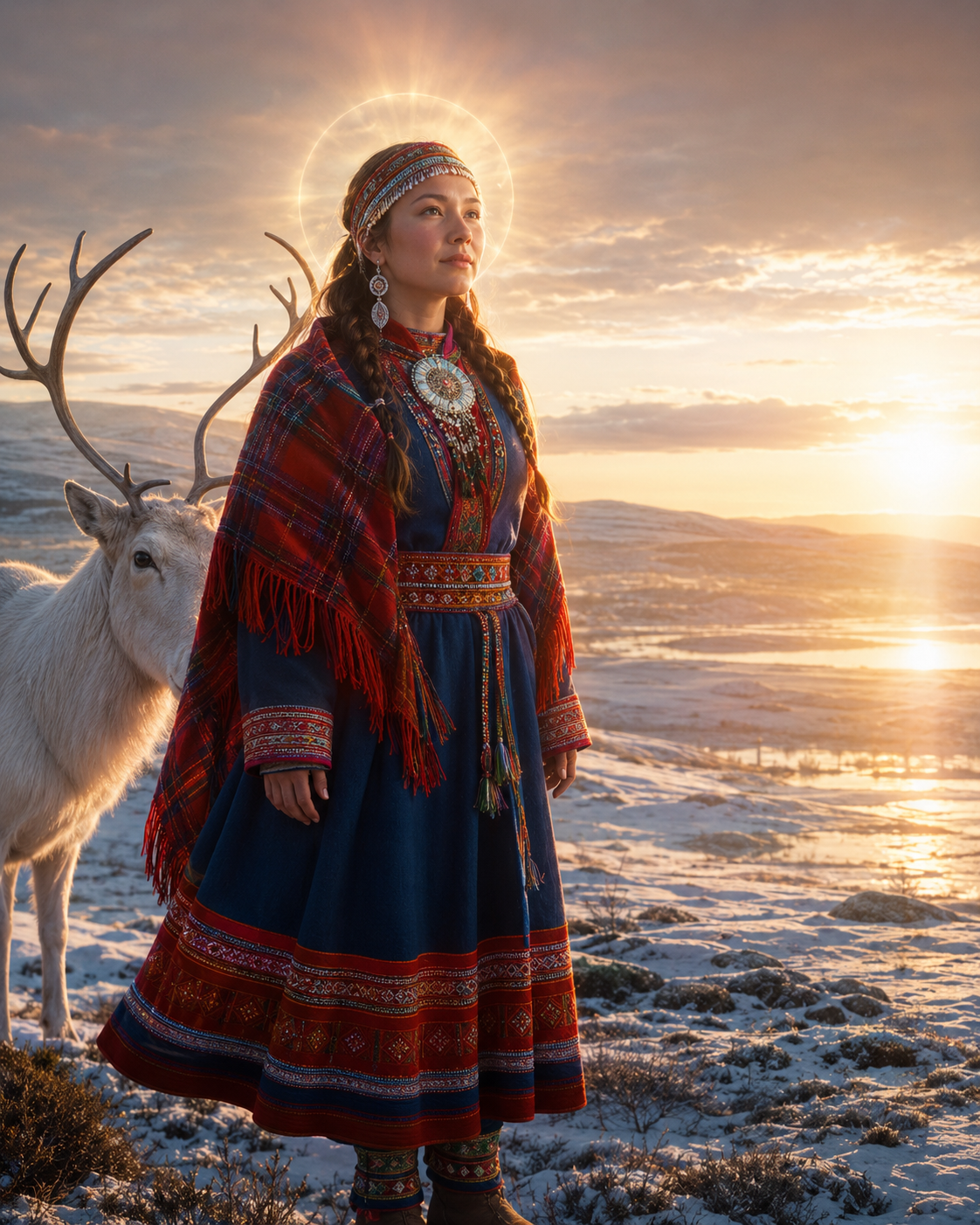 Beaivi—also rendered Beivve, Bievve or Biejje, and sometimes written Bea’vi—is the Sámi solar deity. In many recorded traditions Beaivi is female, although the sun can be represented as male elsewhere in Sápmi. She is associated not simply with daylight but with spring, fertility, the growth of plants, the reproduction of reindeer and the restoration of emotional and mental health after the long Arctic darkness.
Later ethnographic accounts describe ceremonies welcoming the returning sun. Butter, which melts in sunlight, could be offered or placed upon doorways to strengthen Beaivi on her ascent. Rings and circular forms evoked the sun’s movement. White reindeer were associated with her worship in some recorded traditions.
These reports should not be transformed into a supposedly universal Sámi ritual calendar. Much of the written material was collected by outsiders after generations of Christianization. But the central relationship is unmistakable: the sun was not merely an object crossing the sky. Beaivi restored the living world.
She also restored the human mind. In the far north, the disappearance of sunlight was understood to affect thought, mood and behavior. Prayers associated with Beaivi’s return therefore joined cosmic renewal to personal healing. The world and the individual recovered together.
The Daughter of the Sun
Beaivi does not always travel alone.
Some accounts call her daughter Beaivi-nieida, the Sun Maiden. A related South Sámi name, Biejjenniejte, literally means “Daughter of the Sun.” She is described as a goddess of medicine and healing, particularly connected with illnesses associated with the sun or its absence. The form Beive-neida was translated in an early Swedish reference work as “Sun Maiden.”
In one beautiful version of the tradition, Beaivi and her daughter travel through the sky within an enclosure formed from reindeer bones or antlers, carrying spring back into the world.
The mother and daughter should not be forced into a rigid family tree. Beaivi-nieida, Biejjenniejte and other solar-maiden names may preserve related but regionally distinct traditions. Nor should the Daughter of the Sun automatically be confused with Rana Niejta, a separate green or spring maiden in some Sámi accounts.
What survives is the image of feminine solar power expressed across generations. The mother is the returning sun; the daughter is its healing presence. Together they awaken the plants, reindeer and people from the perilous suspension of winter.
That image gives the Kola landscape a very different sacred center from the one proposed by Hyperborean enthusiasts. Its central mystery is not an underground machine or vanished city. It is the recurring miracle of life returning after darkness.
Meandash, the Reindeer Between Worlds
Kola Sámi tradition also preserves the stories of Meandash, the mythic reindeer who moves between animal, human and divine existence.
Researchers have recorded nearly thirty Meandash narratives from different Sámi communities of the Kola Peninsula. Taken together, they describe his birth, departure from his mother, marriages with human women, role as a culture hero and eventual transformation into a celestial or solar reindeer.
In these stories, the border separating human beings from animals is permeable. A reindeer can take human form. A human woman can cross into the land of the reindeer. Marriage unites different orders of existence. Rivers of blood divide the mortal world from an ancestral realm, while bones retain spiritual meaning and become the framework of dwellings.
Meandash reveals something essential about Sámi mythology: animals are not decorative symbols added to human stories. They possess societies, intelligence, ancestry and sacred authority of their own. The reindeer is livelihood, relative, teacher and cosmic being.
This is far closer to the underlying structure of Sámi tradition than modern attempts to convert every unusual stone into the machinery of a lost civilization.
Hyperborea: The Paradise Beyond Boreas
The word Hyperborea comes from Greek tradition and conventionally means the land “beyond Boreas,” the North Wind. The Hyperboreans were imagined as a blessed people living in a remote northern country untouched by ordinary sickness, warfare and hardship. Their land enjoyed an impossible temperate abundance despite its northern location.
They were especially associated with Apollo. Ancient writers linked them to his sanctuaries, festivals and periodic journeys. Yet classical authors never agreed on where Hyperborea was. It migrated around the edges of ancient geographical knowledge—from northeastern Asia and Scythia to the Atlantic, northern Europe or a distant island beyond the Celtic world. Modern scholarship treats it as a combination of utopian geography, Apollo mythology and fragmentary reports about the far north, including phenomena such as the midnight sun.
No surviving Greek source identifies Hyperborea specifically with the Kola Peninsula.
The comparison nevertheless contains a poetic resonance. Apollo’s return from a northern land was associated with seasonal renewal. Beaivi’s return restored the Arctic world after polar night. Both traditions placed sacred significance in the movement of light.
That resemblance is evocative, but it is not proof of direct transmission. Sámi solar traditions should not be reduced to remnants of Greek religion, nor should they be recruited as evidence for a prehistoric Mediterranean-Arctic supercivilization.
Barchenko and the Search for a Northern Shambhala
The modern transformation of Kola into Hyperborea owes much to Alexander Barchenko, a Russian writer, occult investigator and experimenter who traveled to the Lovozero region in 1922.
The expedition’s stated purpose was connected with an unusual collective psychological condition often called meryachenie. Later accounts, however, portrayed Barchenko as searching for inherited psychic abilities, ancient knowledge and the remains of a polar civilization. The most expansive versions claim that Soviet security officials hoped such knowledge might yield techniques of mental influence or advanced weaponry.
Barchenko belonged to a wider early-Soviet milieu in which occultism, revolutionary universalism, parapsychology and Asian geopolitics briefly intersected. Historian Andrei Znamenski’s work on “Red Shambhala” examines Bolshevik interest in adapting Buddhist and Central Asian prophecies to revolutionary projects.
But Shambhala originated within the Indian and Tibetan Buddhist Kālacakra tradition. It was a hidden kingdom preserving sacred teaching—not originally an Arctic civilization beneath the Kola tundra. The transfer of Shambhala to northern Russia was a modern occult synthesis combining Tibetan Buddhism, Theosophy, European lost-continent speculation and Russian fascination with the Arctic.
The uploaded “Did the Russians Find the Mythical Shambala?” file does not preserve a usable version of its underlying article; it is principally a saved Google Translate wrapper. It demonstrates how the Shambhala framing circulated online, but it cannot support the article’s historical claims independently.
The Alleged Kola Pyramids
The most dramatic modern claims concern two mountain formations described as enormous, deliberately constructed pyramids.
The popular articles in the source packet assert that these structures are approximately 9,000 years old—twice the age of Egypt’s pyramids—and contain internal chambers detected by geophysical instruments. One article connects them directly with Barchenko and Hyperborea; another repeats the claims as a discovery capable of rewriting human history.
But neither article supplies a peer-reviewed excavation report, documented artifacts, reproducible dating evidence or an archaeological publication establishing human construction. Even the AncientPages article acknowledges that Barchenko’s ideas were never confirmed.
The uploaded Seydozero article goes further, describing paved roads, precisely cut blocks, stairs, an observatory, an underground repository and a map of Kola supposedly reproducing the constellation Orion. These are presented through expedition anecdotes and visual interpretations rather than conventional archaeological documentation.
By contrast, the scientific geological paper explains the Lovozero region through ancient volcanism, intrusive rock bodies, erosion and mineralogical processes. It does not report artificial pyramids or a prehistoric architectural complex.
The responsible conclusion is therefore not that the pyramid story has been disproved in every conceivable detail. It is that the extraordinary archaeological claims remain unsupported by the evidence presented. What has been demonstrated is a remarkable natural landscape upon which modern observers have projected architectural forms.
A Landscape in Danger of Being Overwritten
The greatest problem with the Hyperborean interpretation is not simply that it lacks proof. It can also overwrite the people whose sacred history genuinely belongs to the land.
The Sámi suffered missionary pressure, state assimilation, restrictions upon language and ritual, and, in Soviet Russia, collectivization and forced concentration into permanent settlements. The Lovozero travel account in the source material describes the disruption of traditional herding communities, the relocation of Sámi families and the environmental burden created by mining, industrialization and military development.
Today, tourism adds another layer. The Arctic tourism study included in the packet recognizes the region’s extraordinary natural and cultural attractions but also warns that expanded visitation to protected areas requires ecological limits and responsible management.
Calling Seydozero “Russian Shambhala” may attract travelers. Advertising journeys into “Hyperborea” may sell tours. Yet sacred places can be damaged when their living cultural meanings are converted into evidence for someone else’s fantasy.
Kuiva is not merely a photograph to be collected. A sieidi is not an archaeological prop. Beaivi is not the queen of an invented Aryan polar empire. These belong first within Sámi histories and relationships.
What May Truly Survive at Seydozero
There may be no lost metropolis beneath the Lovozero mountains. The apparent pyramids may be mountains, and the underground chambers may be fissures within an extraordinary igneous formation.
But that does not leave Seydozero empty of mystery.
A cliff still carries the form of Kuiva. Stones still stand in places where offerings were once made. The names of lakes and mountains preserve languages that states repeatedly tried to erase. Stories of Meandash still remember a time when reindeer and human beings could cross into one another’s worlds. And every winter, Beaivi vanishes—only to return with her daughter and restore life to the Arctic.
Hyperborea may never have existed as a city or continent. Yet the longing behind it—the belief that wisdom survived somewhere beyond the North Wind—continues to draw outsiders toward Kola.
The irony is that a northern tradition of extraordinary depth was already there. It did not need pyramids, secret technology or a vanished master race. It needed only the sun, the reindeer, the sacred stone and the people who knew how to listen to the land.
Further Reading
Sámi religion and Beaivi
- Sámi Museum Siida, “Beaivi.” A Sámi museum resource presenting the sun as one of the central powers of the natural world and describing humanity’s relationship to Beaivi within Sámi belief.
- Sámi Museum Siida, “Mythology.” A useful introduction to the regional character of Sámi sacred traditions and the importance of specific deities, landscapes and offering places.
- Louise Bäckman, Studies in Lapp Shamanism. A major scholarly collection examining Sámi cosmology, ritual specialists, drums, sacrifice and the relationship between religion and landscape.
- Rafael Karsten, The Religion of the Samek: Ancient Beliefs and Cults of the Scandinavian and Finnish Lapps. An influential older study containing material on Beaivi, solar worship and other Sámi divine figures. It should be read critically because much of the evidence was recorded by non-Sámi researchers after extensive Christianization.
Beaivi’s daughter and Sámi solar traditions
- Herman Hofberg, “Lapparnes hedna tro.” A nineteenth-century account frequently cited for descriptions of Beaivi, the returning sun, ritual butter offerings and the Sun Maiden. Like other early ethnographic sources, it reflects the terminology and assumptions of its period.
- Nordisk familjebok, entry on Sámi religion. An early reference identifying Beive-neida as the “Sun Maiden,” one of the names associated with Beaivi’s daughter and healing power.
- Sámi Museum Siida’s online cultural collections. These provide valuable context for understanding Sámi traditions from Sámi-centered museum interpretation rather than treating the religion as a single, fixed mythology.
Kola Sámi stories and Meandash
- Enn Ernits, “Folktales of Meandash, the Mythic Sámi Reindeer,” Parts I and II. A detailed scholarly study of nearly thirty narratives recorded among the Sámi of the Kola Peninsula. The articles trace Meandash as reindeer ancestor, husband, culture hero and celestial being.
- V. Charnolusky, collections of Kola Sámi folklore. Charnolusky recorded important twentieth-century material concerning Meandash, sacred geography and Kola Sámi oral tradition. His work is frequently discussed in later folklore scholarship.
The Kola Peninsula and Lovozero
- Gennady P. Luzin, Michael Pretes and Vladimir V. Vasiliev, “The Kola Peninsula: Geography, History and Resources,” Arctic 47, no. 1 (1994). A scholarly overview of the peninsula’s geography, settlement, industrialization, military significance and environmental history.
- A. A. Arzamastsev and M. N. Petrovsky, “Alkaline Volcanism in the Kola Peninsula, Russia.” A geological study of the Khibiny, Lovozero and Kontozero formations. It provides the scientific background necessary for evaluating claims that naturally layered mountains or rock formations are artificial structures.
- “Lake Seydozero: Traces of an Ancient Civilization.” A wide-ranging presentation of Seydozero legends, Kuiva, expeditions and alleged archaeological anomalies. It is useful as a record of modern Hyperborean interpretation, although its extraordinary claims require independent verification.
- “The Great Russian North, Part 9: Lovozero.” A readable travel account covering Lovozero, Sámi history, reindeer culture, Soviet relocation and contemporary life on the peninsula.
Hyperborea, Shambhala and Russian occult exploration
- Andrei Znamenski, Red Shambhala: Magic, Prophecy, and Geopolitics in the Heart of Asia. The strongest modern historical treatment of the strange intersection of Bolshevism, occultism, Tibetan prophecy, intelligence activity and revolutionary politics.
- John Godwin, Arktos: The Polar Myth in Science, Symbolism, and Nazi Survival. A broad history of how Hyperborea, polar homelands and occult northern civilizations entered modern esoteric thought.
- Joscelyn Godwin, The Theosophical Enlightenment. Helpful for understanding the European occult movements that transformed ancient geographical myths into theories of vanished superior civilizations.
- Herodotus, Histories, Book IV; Pindar, Pythian Ode 10; and Diodorus Siculus, Library of History, Book II. Principal classical texts for the Greek Hyperborean tradition. They portray Hyperborea as a distant blessed land associated with Apollo, but do not identify it specifically with the Kola Peninsula.
Modern “Kola pyramid” claims
- “Mysterious Kola Pyramids Built by an Unknown Lost Ancient Civilization.” A clear example of the popular claim that Kola’s formations are artificial and approximately 9,000 years old. It is best read alongside geological research because it does not provide a peer-reviewed excavation report or secure archaeological dating.
- “Pyramids Discovered in Russia Twice as Old as Egyptian.” Another widely circulated version of the same argument, useful for tracing how the Kola–Hyperborea narrative spread through alternative-history media.
- “Did the Russians Find the Mythical Shambala?” A source illustrating the modern fusion of Barchenko, Kola, Shambhala and Soviet occult research. The saved copy is incomplete, so its claims should be corroborated through stronger historical sources.
Responsible cultural interpretation
- Sámi Museum Siida. The best general starting point for Sámi-centered interpretation of history, material culture, traditional knowledge and the relationship between northern nature and Sámi life.
- D. V. Sevastyanov et al., “Arctic Tourism in the Barents Sea Region: Current Status and Boundaries of the Possible.” Useful for understanding the opportunities and ecological limits of tourism around culturally and environmentally sensitive Arctic sites.