“Oksana is a fierce and adaptive heroine at the heart of this novel. Her quest for personal liberation through knowledge and reading is an inspiring facet throughout the novel, highlighting the timeless importance of literacy and the revolutionary power of storytelling.”
https://www.selfpublishingreview.com/2026/07/review-the-matriarch-mission-by-maxime-trencavel
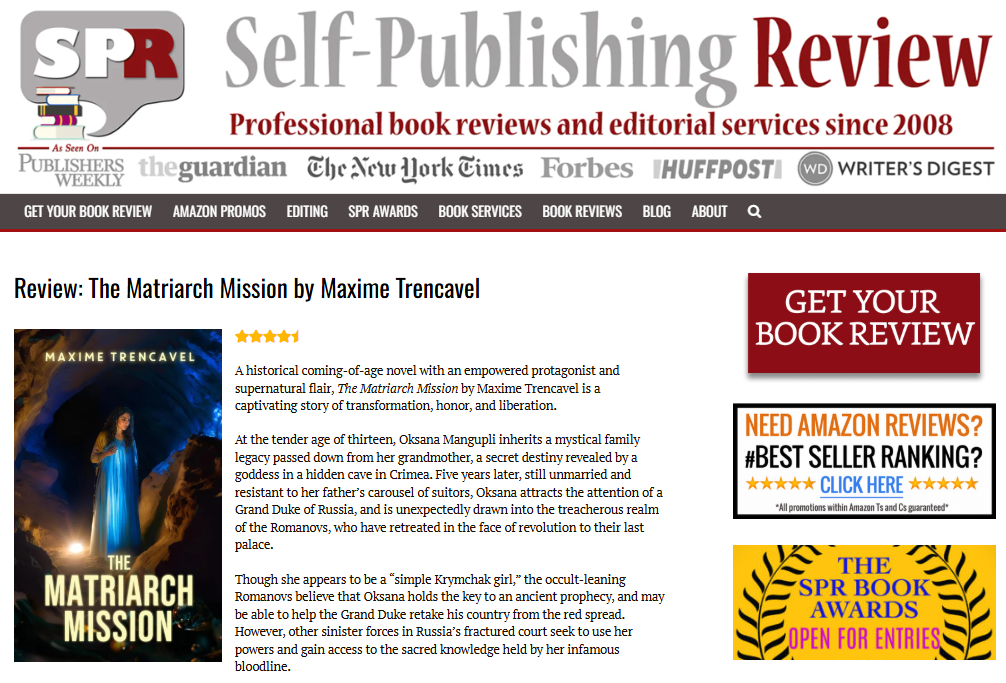
Review: The Matriarch Mission by Maxime Trencavel
A historical coming-of-age novel with an empowered protagonist and supernatural flair, The Matriarch Mission by Maxime Trencavel is a captivating story of transformation, honor, and liberation.
At the tender age of thirteen, Oksana Mangupli inherits a mystical family legacy passed down from her grandmother, a secret destiny revealed by a goddess in a hidden cave in Crimea. Five years later, still unmarried and resistant to her father’s carousel of suitors, Oksana attracts the attention of a Grand Duke of Russia, and is unexpectedly drawn into the treacherous realm of the Romanovs, who have retreated in the face of revolution to their last palace.
Though she appears to be a “simple Krymchak girl,” the occult-leaning Romanovs believe that Oksana holds the key to an ancient prophecy, and may be able to help the Grand Duke retake his country from the red spread. However, other sinister forces in Russia’s fractured court seek to use her powers and gain access to the sacred knowledge held by her infamous bloodline.
Navigating the slippery slopes of court intrigue, losing herself in the throes of actual romance, and dodging manipulative puppet masters in the shadows, Oksana is a fierce and adaptive heroine at the heart of this novel. Her quest for personal liberation through knowledge and reading is an inspiring facet throughout the novel, highlighting the timeless importance of literacy and the revolutionary power of storytelling.
Trencavel’s mastery of historical portraiture makes the reading experience both educational and effortless, without dulling the read with excessive exposition or dry context. The book’s thematic focus on the divine feminine also adds definitive appeal for contemporary readers, given the growing resentment against entrenched patriarchy and the rising demand for matriarchal influence on our modern world. More specifically, the prose highlights and challenges the oppressive treatment of women as property to be sold, traded, and bargained with as pawns on a board or livestock in a pen.
Every character on the page feels imbued with their own agency and personality, easily blurring the line between historical fact and well-crafted fiction. From the shadowy Murometz and foreboding Evegeniia to charming Mirko and irrepressible Oksana, each figure is beautifully developed in their motives and origins, where their hidden desires, esteemed pedigrees, and murky backgrounds add fascinating depth and dimension. Clear-cut lines of good and bad are passed over in favor of a greyscale morality, one that is not only more realistic, but allows for meaningful probing into the nature of oppression, othering, gender, and power.
On a technical level, the prose is decorated with subtle splashes of playful language, artful syntax, and creative descriptive passages, helping readers fully lose themselves in this eloquently summoned world. There are some lapses in the realism of the language, both in the form of anachronistic terms or overly Westernized phrases that feel inauthentic to the culture and character, creating subtle cracks in the facade of the narrative; this may be overlooked by some readers, but historical fiction fans are skilled at noticing gaps in an author’s illusion.
These minor execution errors aside, the remarkable character development, timely themes, and consistently evocative prose make this an exceptional start to a strikingly original series.