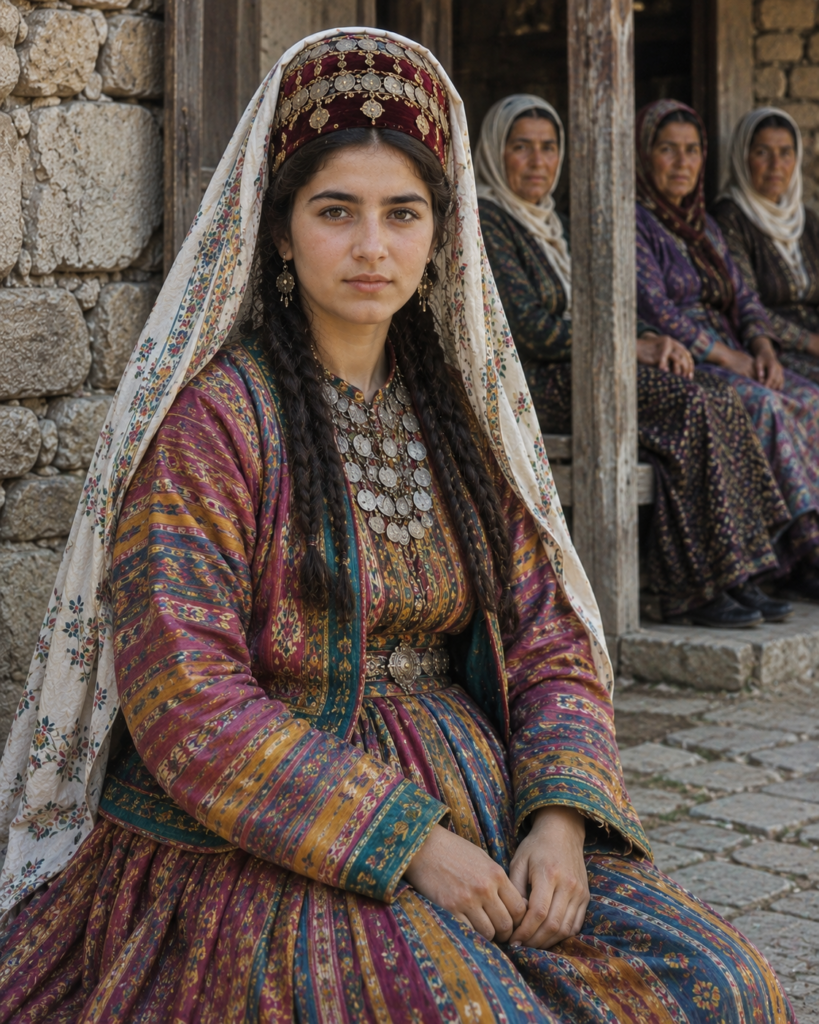
The Matriarch Mission’s main character is a fictional young Krymchak woman. Who are these Krymchaks and why did “history” erase them?
There is a place on the tenth kilometer of the Simferopol-Feodosia highway where every year on December 11, a small group of people gather to recite Kaddish. They call the day Tkun — from the Hebrew tikkun, meaning mending, or the restoration of order. Most of them no longer speak the language their grandparents spoke. Most of them live scattered across Israel, Russia, Ukraine, and the United States, connected to each other and to this place by little more than memory and a grief that has never fully found its name. They are Krymchaks, the Jews of Crimea,and they are among the last of a people who lived on the Crimean peninsula for two thousand years.
Today there are approximately 1,200 to 2,000 Krymchaks left in the world. Five to seven of them are fluent speakers of the Krymchak language. The community that produced Oksana Mangupli — the protagonist of The Matriarch Mission — stood at roughly nine thousand people in 1941. Within months, the Nazis killed six thousand of them. The Soviet state then administratively erased the survivors: in the  USSR, passports could list any ethnic nationality except Krymchak. Those who remained were recorded as Jews or Crimean Tatars. Soviet bureaucracy explained its logic plainly: we believe that if you were under occupation, then you were destroyed. And if you were destroyed, then Krymchaks no longer exist.
Oksana does not know any of this in 1922. She knows only the world that made her.
A People Shaped by Two Thousand Years of In-Between
The Krymchaks were never quite anything else. They were not Ashkenazi, not Sephardi, not Karaite, not Tatar — and yet they were, in different proportions, all of these things and more. The first Jewish communities on the Crimean peninsula arrived with Greek colonization along the Black Sea coast, possibly as early as the first century BC, and the cemetery inscriptions and slave-liberation documents they left behind mark the beginning of one of the longest continuous Jewish presences anywhere in the world.
Over the following two millennia, waves of Jewish migrants arrived and were absorbed: refugees from Byzantine persecution, merchants from Constantinople, ransomed captives of Ashkenazi origin brought to Crimea by Tatar raiders, scholars from Italy and Spain, traders from Georgia and Persia. One of the most significant arrivals was Mosheh ha-Goleh — Moses the Exile — a Talmudic scholar from Kiev who came to Crimea in the fifteenth century and spent decades reconciling the community’s divergent practices into a single unified prayer tradition. The result was the Nusah Kaffa, named for the ancient city of Kaffa — now Feodosia — which had been the community’s spiritual center for centuries. It incorporated elements of Byzantine, Sephardi, Romaniote, and Ashkenazi practice into something found nowhere else on earth.
The Krymchaks spoke Crimean Tatar as their vernacular — a Turkic language they wrote in Hebrew characters, producing texts in which the grammar and phonology were Tatar while the sacred vocabulary and syntactic structures were Hebrew and Aramaic. Their family journals, called jönk, were passed from father to eldest son, containing stories, proverbs, personal accounts, and recipes in this hybrid script. Their prayer books faced south, like a mosque, rather than east, like a synagogue. The Crimean Tatars called them zuluflu chufutlar — Jews with earlocks — to distinguish them from the Karaites next door, who were zulufsuz chufutlar — Jews without earlocks. Even the folk taxonomy that named them was comparative, relational, defined by proximity to others.
This in-between quality was not a weakness. It was the community’s genius and its survival strategy across two thousand years of changing rulers. Byzantine, Genoese, Tatar, Ottoman, Russian — each power in turn had controlled the Crimean peninsula, and the Krymchaks had navigated each transition by being flexible enough to absorb the dominant culture without dissolving into it. They dressed like Tatars, cooked like Tatars, spoke Tatar in the market and Hebrew in the synagogue, and remained recognizably, stubbornly themselves.
The World That Made Oksana
By 1922, when Oksana leaves Crimea on the expedition to the Kola Peninsula, the community she comes from is already living through its third major disruption in five years. The Civil War and the famine of 1921–22 had killed seven hundred Krymchaks. Others had emigrated to Palestine and the United States. The census of 1926 would count 6,383 Krymchaks in the Soviet Union, down from perhaps twice that number a generation earlier.
But the community was still intact in its essential structures. Traditional religious education of Krymchak children was still being conducted in the mid-1920s. The synagogues still faced south. The jönk were still being passed down. The Tkun memorial had not yet been necessary — the massacre that would make it necessary was still twenty years away.
What the community gave Oksana, before it gave her anything else, was a complete moral architecture. Duty, obedience, and honor were not abstract concepts in Krymchak life — they were lived through specific, codified relationships. The patriarchal nature of the family was preserved well into the late nineteenth century. Girls married young, often to relatives, in unions arranged by families rather than chosen by individuals. A widow could never remarry, because husband and wife were considered inseparable even after death. The family’s practice of charity was communal and obligatory: no beggars existed among them because the community ensured that the poor received firewood, flour, and candles. These were not individual acts of generosity but the discharge of collective duty.
For Oksana, this means that when her father arranges her marriage, he is not acting capriciously. He is fulfilling his role in a system of obligations that extends in every direction: to the community, to God, to the family’s honor, to her future. When she chafes against the marriage, she is not simply rebelling against one man’s decision. She is in tension with the entire architecture of meaning her world rests on. Obedience to the father is obedience to the community is obedience to God. The chain of duty is seamless and total.
And yet her baba — her grandmother — had given her something that complicated this architecture from the inside. Not a rejection of duty, but a different account of where duty ultimately comes from. The baba’s insistence on following the words of Asherah — the ancient goddess whose voice Oksana has been taught to hear, the divine feminine that predates the patriarchal structures layered over it — does not contradict Krymchak faith so much as reach beneath it. The Krymchak tradition itself carried traces of this deeper layer. Their mystical practice drew on Kabbalistic streams — the Zohar, the practical Kabbalah of Isaac Luria — in which the divine feminine, the Shekhinah, was not a marginal figure but the very presence of God in the world, the aspect of divinity that dwells among human beings and weeps when they suffer. The baba’s teaching is not heresy. It is the oldest part of the tradition made primary.
This is Oksana’s specific tension, and it is not resolvable in the terms her world provides. The Krymchak world says: obey your father, honor your husband, fulfill your role in the chain of obligation that holds the community together. The baba says: listen to the voice that speaks beneath all those obligations, the voice that was there before your father and will be there after. When those two authorities align — when her father’s demand and the deeper voice say the same thing — Oksana can act without conflict. When they diverge — when duty requires what the deeper voice refuses, or when the deeper voice calls her somewhere duty does not permit — she is in the territory the novel inhabits.
The Language of Honor
What made Krymchak obedience different from simple submission was that it was mutual and covenantal. The kitubu — the marriage contract entered before the wedding — specified not only the wife’s obligations but the husband’s, and included a bail the man’s family would forfeit in case of divorce. This was not sentimentality. It was contract law. The chain of obligation ran in both directions: the husband owed the wife as much as she owed him, the father owed the daughter as much as she owed the father. Honor was not simply what women owed men. It was what everyone owed everyone, in a community small and tight enough that every defaulted obligation was visible.
Oksana’s problem with Yuri is not only that he is cruel, though he is. It is that he has broken the covenant. He has taken what the contract promised him and given nothing in return. In Krymchak terms, this is not merely personal failure — it is a violation of the order that holds everything together. Her suffering is real and particular, but its meaning in her framework is structural: a man who does not honor his obligations has severed himself from the web of mutual duty that makes community possible. That Oksana stays as long as she does is not weakness. It is the Krymchak moral logic working exactly as designed — the system asks her to absorb the failure of others rather than let the community fracture.
That she eventually leaves, that she finds her way north and then further north toward something the Krymchak world has no category for, is the novel’s central movement. She does not leave because she has stopped believing in duty and honor. She leaves because the baba’s voice finally tells her that the duty she owes the deepest thing in herself has become incompatible with the duties her community demands. That is a different kind of obedience — not less demanding but more absolute.
What Was Lost
The community Oksana came from does not survive the twentieth century intact. The Nazis debated whether Krymchaks qualified as Jews. The SS carried out formal research into the community’s background before reaching their conclusion. The delay between the roundups of Ashkenazi Jews and Krymchaks in each Crimean city — twelve days in Feodosia, forty-five days in Karasu-Bazar — was the interval in which Krymchaks watched their neighbors being taken and understood what was coming. Bakhchisarai, December 13, 1941: ninety Krymchaks killed. Simferopol, December 9: fifteen hundred. Kerch, December 1–3: an entire city’s Jewish population including all its Krymchaks. Feodosia, November 17: gas vans.
Those who survived the Holocaust were then required by Soviet bureaucracy to stop existing as Krymchaks. Their passports listed them as Jews or Tatars. The category was erased. The jönk — those family journals in Hebrew-Tatar script passed from father to son — stopped being produced. The language, which had already lost most of its speakers, lost the rest. By 2001, fewer than 785 Krymchaks remained in Crimea. Worldwide today: perhaps 1,200 to 2,000, most of them in Israel and Russia, most of them Russian-speaking, most of them connected to the tradition by little more than memory and the annual gathering at the tenth kilometer of the Simferopol-Feodosia highway.
Five to seven fluent speakers of the Krymchak language remain alive in the world.
The word the survivors chose for their memorial day is Tkun — tikkun — mending. The repair of what has been broken. It is a Kabbalistic concept: the idea that the divine light shattered at the moment of creation, and that human acts of justice and compassion gather the scattered sparks and restore what was lost. The baba would have understood it. It is, in its way, exactly what Asherah asked Oksana to do.
The Matriarch Mission is set in 1922, before any of this destruction. But Oksana carries the world that will be lost — its obligations, its languages, its covenantal understanding of honor, the baba’s deeper teaching running beneath it all. She does not know she is among the last generation who will know this world fully from the inside. The reader does.
References and Further Reading
The following sources corroborate the historical claims in this account. Where primary documentation is limited, the most authoritative available scholarship is indicated.
Primary Encyclopedic and Scholarly Sources
“Krimchaks.” Encyclopaedia Judaica. Jerusalem: Keter Publishing, 1972. Reprinted in Jewish Virtual Library. The foundational English-language scholarly entry on the community, covering demography, history, religious tradition, and the Holocaust. jewishvirtuallibrary.org/krimchaks
Zand, Michael. “Krymchaks.” In Gershon David Hundert, ed., The YIVO Encyclopedia of Jews in Eastern Europe, vol. 1. New York: YIVO Institute for Jewish Research / Yale University Press, 2008, pp. 948–951. The authoritative scholarly treatment in English, drawing on Russian, Hebrew, and Krymchak-language primary sources. encyclopedia.yivo.org/article/91
Achkinazi, Igor Veniaminovich. Krymchaki: Istoriko-etnograficheskii ocherk [The Krymchaks: A Historical-Ethnographic Study]. Simferopol, 2000. The primary Russian-language monograph on Krymchak history and ethnography. The foundational source for most subsequent scholarship on the community.
Khazanov, Anatoly. The Krymchaks: A Vanishing Group in the Soviet Union. Jerusalem: The Marjorie Mayrock Center for Soviet and East European Research, Hebrew University of Jerusalem, 1989. Documents the community’s Soviet-era demographic decline and the administrative erasure of the Krymchak ethnic category.
On the Holocaust of the Krymchaks
Spector, Shmuel. “Sho’at hayehudim hakrimchakim bitkufat hakibbush hanatzi” [The Holocaust of the Krymchak Jews During the Nazi Occupation]. Pe’amim 27 (1986): 18–27. Hebrew-language study of the systematic killing of the Krymchak community by Einsatzgruppe D.
Loewenthal, Rudolf. “The Extinction of the Krymchaks in World War 2.” The American Slavic and East European Review 10 (1951). Early English-language documentation of the destruction of the community.
“The Holocaust of the Krymchaks.” Yad Vashem — The World Holocaust Remembrance Center. Draws on Achkinazi, Spector, and Loewenthal to document the SS research into Krymchak classification, the timeline of killings across Crimean cities, and community population calculations. yadvashem.org/research/about/mirilashvili-center/articles/holocaust-krymchaks.html
On Krymchak Language and Written Culture
“Krymchak.” Jewish Languages Project. Harvard University. Documents the hybrid Hebrew-Tatar script, the jönk family journal tradition, liturgical texts including the 1904 Haggadah, and the language’s current near-extinction. jewishlanguages.org/krymchak
“Krymchak Language.” Wikipedia. Sourced survey drawing on linguistic scholarship, documenting the community’s demographics by decade from 1897 through 2001, the impact of the 1944 Tatar deportation on Krymchak language survival, and the current estimate of five to seven fluent speakers worldwide. en.wikipedia.org/wiki/Krymchak_language
On Community Identity and Soviet-Era History
“Krymchaks.” Encyclopedia.com, drawing on the Encyclopedia of World Cultures. Documents the Soviet administrative erasure of the Krymchak ethnic category, the post-war pressure to adopt a non-Jewish ethnic origin myth, and the community’s material culture and marriage traditions. encyclopedia.com/humanities/encyclopedias-almanacs-transcripts-and-maps/krymchaks
“Krymchaks.” Wikipedia. Synthesized scholarly entry covering origins, language, religious tradition, Holocaust, and current population. Notes the 2000 population estimate of approximately 600 in the former Soviet Union and 600–700 maintaining Crimean identity in Israel. en.wikipedia.org/wiki/Krymchaks
On the Living Community
Lombroso, Viacheslav, interviewed in: “Krymchaks of Ukraine. Who Are They?” Ukraїner, June 2023. The most detailed recent English-language profile of a living Krymchak, documenting the Tkun memorial, the community’s response to the 2014 Russian occupation of Crimea, the Soviet passport erasure, and contemporary preservation efforts. ukrainer.net/en/krymchaks/
“Krymchaks. Who Are They?” Crimean Tatar Resource Center, 2023. Documents current world population estimate of approximately 1,200. Includes note on American film director Ralph Bakshi as a notable Krymchak descendant. ctrcenter.org/en/krymchaks-who-are-they
“Indigenous Peoples in Ukraine You May Have Never Heard About.” UkraineWorld, 2021. Places the Krymchaks within Ukraine’s indigenous peoples framework alongside Crimean Tatars and Karaites. Notes the unique orientation of the Krymchak synagogue facing south rather than east. ukraineworld.org/en/articles/opinions/indigenous-peoples-ukraine-you-may-have-never-heard-about
On the Tkun Memorial and Language Extinction
The memorial day observed on December 11 each year at the tenth kilometer of the Simferopol-Feodosia highway is documented in the Ukraїner profile above and in the Jewish Languages Project entry. The word Tkun — from the Hebrew tikkun, meaning mending or restoration — and its significance as one of the last Krymchak words in active use is noted in the Jewish Languages Project documentation of post-Holocaust memorial poetry.
The 2001 Ukrainian census figure of fewer than 785 Krymchaks remaining in Crimea is sourced to the Krymchak Language Wikipedia entry, which draws on Ukrainian state census data. The estimate of five to seven fluent speakers worldwide is from the same source.
Note on Source Limitations
The most substantive primary scholarship on the Krymchaks — Achkinazi’s 2000 monograph, Spector’s 1986 study, Moskovicz and Tukan’s 1982 Hebrew-language community history in Pe’amim 14 — exists primarily in Russian, Hebrew, and Krymchak, with limited English translation. The English-language sources cited above draw on this scholarship. Readers seeking the deepest primary documentation are directed to the YIVO Encyclopedia entry, which provides the most complete bibliography of the available scholarship across languages.